
Diesel Portable Air Compressor: CFM/PSI Sizing, Fuel Cost, and Maintenance Guide
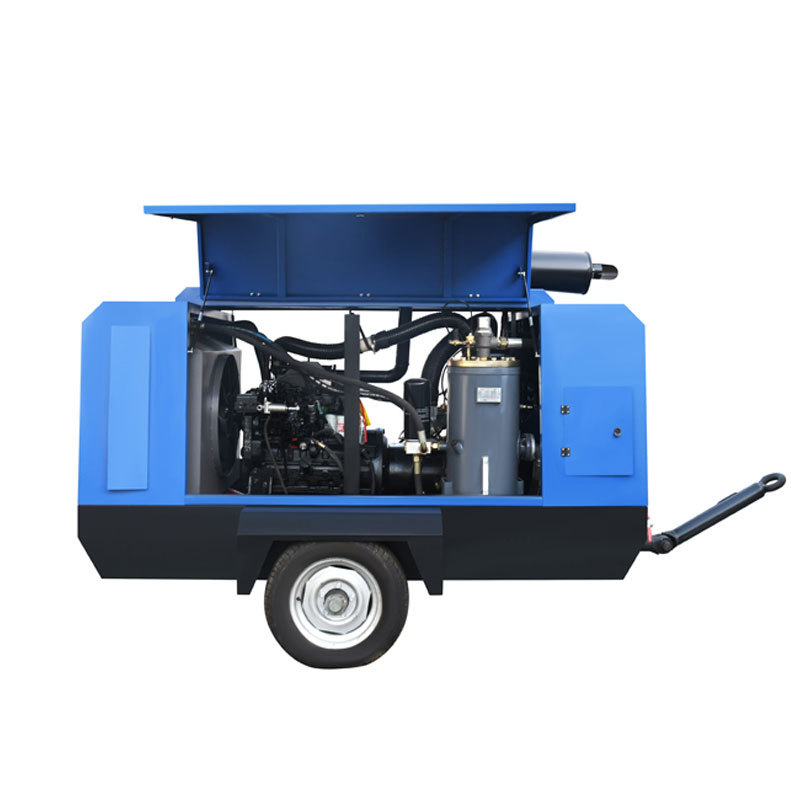
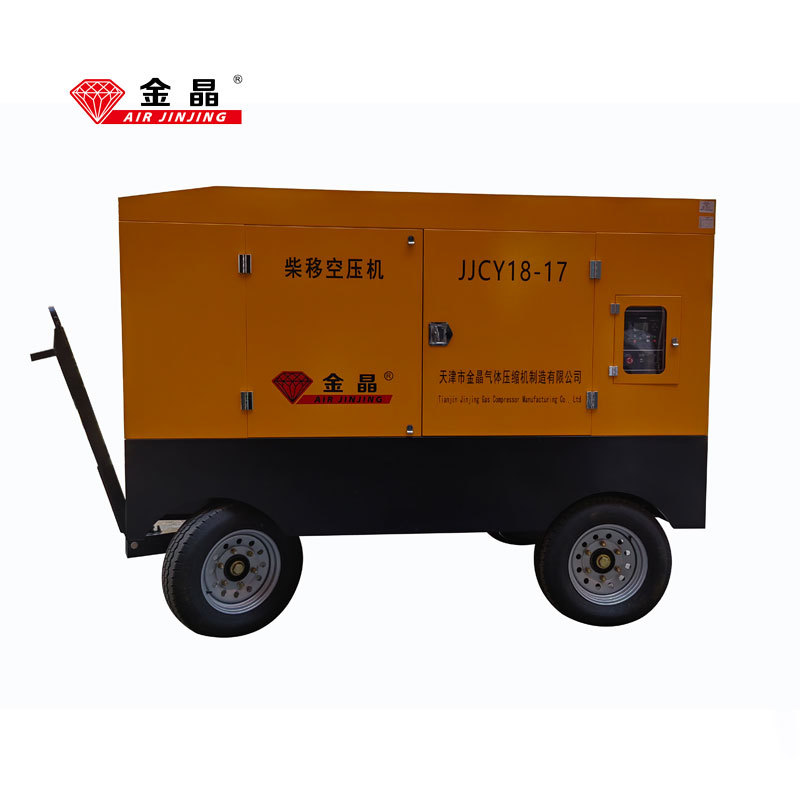
A diesel portable air compressor is a self-contained, engine-driven compressed air unit built to be moved between jobsites — most commonly a towable, trailer-mounted rotary screw compressor, or a skid-mounted unit that is lifted onto a truck bed, flatbed, or platform. Because it carries its own diesel engine, it delivers full air output where there is no power line, no generator, and no time to run cable.
That independence is exactly why rental fleets and contractors treat these machines as a utilization asset rather than a single-purpose tool. As one major compressor distributor puts it, diesel units "provide the performance of a truck engine-driven compressor with the ability to run independently," and when operated as part of a fleet they "reduce engine idle time while also decreasing emissions and maintenance costs."
This guide covers the four decisions that determine whether a diesel portable air compressor pays for itself: how to size it, what it will cost in fuel, which configuration to specify, and how to service it so it does not cost you a shift.
1. What Counts as a Diesel Portable Air Compressor?
Three mounting forms cover nearly every jobsite requirement:
| Configuration | How it moves | Best for |
| Towable / trailer-mounted | Highway-rated running gear, pintle or ball hitch | Contractors moving between sites weekly or daily |
| Skid-mounted | Lifted by forklift or crane onto a truck bed or platform | Permanent installs, long-term flatbed mounting, offshore and marine packages |
| Utility / truck-mounted | Bolted to a service truck chassis | Field service, mobile repair, pipeline and utility work |
Output range across the class runs from roughly 185 to 1,600 CFM at 100 to 500 PSI. On the distribution side, the standard towable and truck-mounted sizes are quoted as 80, 185, 375, 400, 800, and 900 CFM — those six numbers cover the overwhelming majority of what is actually bought in North America, with the 185 and 375 classes doing most of the volume.
When diesel is the right answer: no grid power available; multiple pneumatic tools running at once; continuous duty across a full shift; remote, mobile, or seasonal sites. When it is not: an indoor, fixed installation with reliable three-phase power — an electric portable or stationary screw compressor will cost less to own and run. types of air compressor
2. Step 1 — Size the Air: Matching CFM and PSI to Your Tools
Sizing errors are the most expensive mistakes in this category. An undersized machine starves the tool and burns through its own service life; an oversized machine costs more upfront and consumes more diesel per hour than the job requires.
The three workhorse classes
The practical rule used across the industry groups machines by how many tools they carry at once:
| Class | Typical load it carries | Notes |
| 185 CFM class | Two mid-size tools running together (e.g. pneumatic breakers) | The most common contractor size; also the base size for small blasting and utility work |
| 375 CFM class | Three to four tools, or a single blast hose | Where multi-pressure (100/150 PSI) machines usually sit |
| 750 CFM class and above | Heavy blasting, large-scale drilling, multi-tool spreads | A single blast nozzle at 250–400 CFM can consume a 375 almost by itself — this is the case where contractors most often under-buy |
The add-up method
1. List every pneumatic tool that will run at the same time. Not per day — simultaneously.
2. Take each tool's rated air consumption from its nameplate or manual. Do not estimate from memory; pneumatic tool consumption varies widely between models of the same tool type.
3. Total the CFM, then add a safety margin of roughly 20 percent for leakage, hose losses, and future tool additions.
4. Match the pressure, not just the flow. Nearly all common jobsite tools are rated at 90–100 PSI, but specific applications — certain drilling and high-pressure work — require the 150 PSI or 200 PSI class.
5. If your job mixes both pressure levels, specify a multi-pressure machine. Switchable low/high pressure lets one unit serve both a breaker spread and a high-pressure application, which raises utilization and consolidates the fleet instead of forcing two purchases.
Rule of thumb: add the CFM of every simultaneous tool, add 20 percent, then round up to the next standard class. If the total lands just above a class boundary, buy the larger class — jobsite leakage and tool wear reliably eat the difference.
3. Step 2 — Estimate Fuel Cost per Shift
Diesel consumption, not purchase price, is what usually decides the total cost of ownership on a machine that runs every day. The reliable method is to work from the published maximum-load fuel burn figure in gal/h, because that is the number manufacturers publish and the number you can hold a supplier to.
Published maximum-load figures for a comparable towable rental fleet show how sharply fuel burn scales with output:
| Machine class (example models) | Max output | Max pressure | Fuel burn at max load |
| XAVS 400 | 395 CFM | 200 PSI | 7 gal/h |
| XAS 950/750 T4F | 950 CFM | 200 PSI | 13.21 gal/h |
| XAS 1150 T4F | 1,150 CFM | 200 PSI | 14 gal/h |
XRVS 1000 | 1,000 CFM | 508 PSI | 21.3 gal/h |
XRVS 1550 | 1,550 CFM | 508 PSI | 30.7 gal/h |
Source: published specifications on a major US equipment rental page (Carolina Cat).
The formula to run before you buy:
Fuel cost per shift = published gal/h at your expected load
× shift hours
× local diesel price per gallon
Run it at three load levels — 50 percent, 75 percent, and 100 percent — because a machine that spends most of its day at low demand on a 750 CFM platform will cost far more than a correctly sized 375 running near its efficient point.
Four ways to cut fuel cost without buying a smaller machine
1. Match the machine to the real simultaneous load. Over-sizing is the single biggest fuel penalty.
2. Check that automatic idling/unloading is enabled. Most modern units will drop to low-speed operation when the demand valve closes — if the controller is set up wrong, the engine keeps burning at full rate.
3. Service the air and fuel filtration on schedule. A restricted air filter or dirty multi-stage fuel filter shows up as higher fuel burn long before it shows up as a failure. Machines specified for dusty sites and variable fuel quality should carry multi-stage filtration on both sides.
4. Fix leaks and undersized hoses. Hose restriction is invisible in the fuel log but shows up every single day.
4. Step 3 — The Nine-Point Specification Checklist
When you compare two diesel portable air compressors, these are the fields that actually decide price and uptime:
| No | Spec to confirm | Why it matters |
| 1 | Duty cycle(continuous vs intermittent) | Determines whether the machine can run a full shift without derating |
| 2 | CFM at your working pressure | CFM quoted at one pressure is not CFM at another — always compare at the pressure you will use |
| 3 | Pressure class / multi-pressure capability | Buyers who skip this end up with two machines instead of one |
4 | Engine make and rating | Impacts service network, parts availability, and resale value |
5 | Fuel burn at max load (gal/h) | The number that drives total cost of ownership |
6 | Cold-start provision | Pre-heating of intake air is essential for winter work in northern regions |
7 | Service access | Wide, all-round side doors cut maintenance hours per service — measurable over a fleet |
8 | Protection and monitoring | Shutdown protection for high exhaust temperature, low engine oil pressure, high coolant temperature, low coolant level, and low fuel level prevents the failures that end a shift |
9 | Towing and transport compliance | Highway-rated running gear, hitch type, weight, and — for marine or offshore packages — certification requirements |
On point 8, treat the protection list as a diagnostic map: if the unit has shut down, the shutdown reason is almost always one of those five conditions, and the controller display will tell you which one.
5. Step 4 — A Maintenance Schedule That Prevents Downtime
Maintenance on these machines is organized by interval, and the industry-standard framing runs across daily, weekly, monthly, quarterly, and annual routines. The objective is not to follow a checklist for its own sake — it is to prevent the three failures that most often take a diesel portable out of service:
- High oil carry-over in the discharge air — usually filtration, separator, or oil-level related; it contaminates tools and blasting media before it becomes obvious on the gauge.
- Compressor speed limitation / engine bogging down — intake restriction, fuel delivery, or protection-system intervention.
- Hard starting in cold conditions — the reason cold-region packages include an intake air heating device, which brings intake air temperature to roughly 35 °C before starting so the engine turns over cleanly.
- High-altitude and high-temperature operation — sizing the oil-water cooler generously is what keeps output stable on plateau and desert sites rather than relying on the engine to absorb the difference.
Practical rule: log the hours, and treat the machine's own protection events as your early-warning system rather than as inconveniences to reset. A unit that trips repeatedly on the same protection is telling you a service interval was missed. How to maintain an air compressor
6. Where Diesel Portables Win
The application list for this equipment class is broad, and it maps almost exactly onto "places with no power":
| Application | What the compressor runs | ||
| Mining and quarrying | Down-the-hole drills, rock drills, breakers, ventilation and conveying support | ||
| Shipbuilding and ship repair | Pneumatic tools, surface preparation, grinding and finishing | ||
| Municipal and road construction | Breakers, tampers, jackhammers, compaction and demolition tools | ||
Oil, gas and pipeline | Pipeline pressure testing, pneumatic control work, remote site utility air | ||
Sandblasting and surface preparation | Blast nozzles, typically 250–400 CFM each — the highest single-tool demand in the class | ||
Hydropower and water conservancy | Aeration and vacuum support, site pneumatic demand | ||
If the site is remote, the work is dusty, and the machine runs a full shift, diesel portable is not a compromise — it is the only configuration that keeps the tools running.
7. Design Details That Decide Uptime on Remote Sites
Sizing gets you the right machine; the engineering details decide whether it stays on site. These are the design points worth checking line by line before you specify:
Cold-region starting. A diesel portable that will not start at -20 °C is not a portable — it is a seasonal asset. Purpose-designed cold packages pre-heat the intake air so that intake air temperature reaches roughly 35 °C before cranking, which is the difference between a clean start and a shift lost to a no-start condition.
Light-load starting. Forcing the inlet valve closed at the moment of start-up lets the unit come up to speed unloaded. This technique was previously reserved for high-pressure units; on a correctly specified portable it means less wear on the engine, the coupling, and the air end on every single start.
Service access in minutes, not hours. Maintenance hours are the hidden line item in compressor ownership. Units with wide side doors around the whole machine — ideally access on all four sides — turn a filter change into a task that fits inside a normal shift break.
A controller you can read at a glance. The controller should sit on the curbside (away from passing traffic) with an LCD graphic display showing all key operating parameters. When the machine shuts down, the display should tell the operator why in plain language, not through a fault code list in a binder.
Protection set that covers the whole machine. A proper shutdown set covers high compressor exhaust temperature, low diesel engine oil pressure, high engine coolant temperature, low coolant level, and low fuel level. Each one of those protects a different failure mode — and together they are the reason a machine can run unattended on a night shift without destroying itself.
Filtration matched to the site, not the catalogue. Dusty quarry and mining environments justify multi-stage air filtration; sites with variable or lower-grade fuel quality justify multi-stage fuel filtration. Both are specification decisions, not accessories.
Cooling sized for real conditions. A generously sized oil-water cooler is what keeps output and service life stable at high ambient temperature and at altitude, where thin air reduces both cooling and combustion efficiency.
Multi-pressure flexibility. A unit that shifts between low and high pressure at the turn of a switch serves two application profiles with one machine. For a rental fleet, that directly raises utilization; for a contractor, it consolidates capital instead of adding a second unit.
Jinjing's diesel portable screw compressor range is built around exactly these points: cold-start intake air heating, light-load start, all-round maintenance access, full fault display, a five-condition shutdown protection set, multi-stage air and fuel filtration, and an oversized oil-water cooler for high-temperature and plateau work. The range covers truck-mounted mobile units quoted at 100 CFM across 7, 8, 10 and 13 bar pressure settings, through to larger portable diesel screw units in the 239 kW, 264 kW and 410 kW classes — with 18 models listed and downloadable specification sheets.
How do I choose between 185 CFM and 375 CFM?
Count the tools you will run simultaneously. Two mid-size tools points to the 185 class; three to four tools, or a single blast hose, points to 375. If your daily mix varies, size for the worst case and confirm the machine's duty cycle supports it.
Is diesel cheaper than electric for a jobsite compressor?
It depends on the site, not the technology. Where three-phase power is available and the machine stays in one place, electric wins on running cost. Where power is absent or the machine moves, diesel wins on availability — and availability failure is far more expensive than fuel.
How long does a diesel portable air compressor last?
Service life is driven by duty cycle, filtration, and how consistently the machine is serviced at its stated intervals. Units maintained on schedule routinely remain in service for many years and retain resale value, which is why the used market for 185 and 375 class machines is deep and active.
What pressure do I actually need?
Most pneumatic construction tools are rated 90–100 PSI. Specify the 150 or 200 PSI class only for applications that require it — and if you need both, choose a machine with switchable low/high pressure so a single unit covers the whole job.
Can a diesel portable compressor run indoors?
No. Diesel engines produce exhaust emissions and must be operated outdoors or with engineered ventilation. For indoor and enclosed installations, an electric portable or stationary screw compressor is the correct choice.
9. Next Step
If you are sizing a machine for a specific job mix, send us the tool list and the working pressure, and our engineers will return a CFM calculation plus a recommended model from our diesel portable range — including cold-region packages, multi-pressure units, and marine/offshore skid packages. Project cases
Talk to a Jinjing engineer → [Contact us]
Tianjin Jinjing Gas Compressor Manufacturing Co., Ltd. has designed and manufactured air compressors and mining equipment since 2005, with more than 520 employees and a 15,000 m² production facility. Recent projects include an offshore-platform skid-mounted air compressor package for CNOOC, delivered with marine explosion-proof and anti-corrosion design and CCS certification.